 Early Times Report Early Times Report
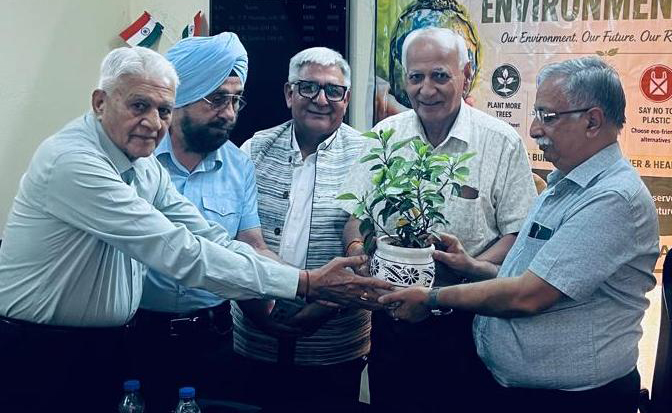
JAMMU, June 8: The Central Govt Pensioners' Welfare Association, Jammu (CGPWA) today organised a special Lecture to celebrate the 53rd World Environment Day to create awareness about the serious challenges arising out of fast degradation of ecosystem and spur action on urgent ecological issues.
Former Additional Principal Chief Conservator of Forests and a member of the Executive Committee of the CGPWA Upender Pachananda delivered an illumination lecture on the Environment Day. In his 30- minutes talk, Pachananda gave an overview of the serious threat the environmental issues pose to the humanity and said that it is a high time that the people realises the seriousness of the challenges that pose existential threat to the mankind globally.
Pachnanda dwelled upon the historical background of the day and said that environment crisis of 1960s compelled the Stockholm Conference held from June 5 to June 16, 1972 to recommend many environment initiatives including World Environment Day. And the UN General Assembly adopted a resolution formally designated June 5th as World Environment Day, specifically choosing the opening date of the landmark Stockholm summit to permanently anchor the occasion.
He said that the first Environment Day was observed on 5th June 1973 with a theme of "Only One Earth". This year's theme is "Inspired by Nature. For Climate. For Our Future". It is dedicated to urgent climate action. It emphasizes learning from nature-based solutions and highlights the pressing need to reduce carbon emissions, transition to renewable energy, and protect ecosystems to avoid critical climate tipping points.
Pachnanda said that since then, June 5th, serves as a vital global platform to raise awareness and spur action on urgent ecological issues. It unites governments, businesses, and citizens across more than 150 countries to address critical environmental issues such as climate change, deforestation, pollution, and biodiversity loss. The day reminds us that protecting our planet is a shared global duty that transcends political borders, he added.
He said that at its core, the concept of the environment encompasses the entire natural world and all living and non-living things that interact within it. It is not just the wilderness, but a complex, interconnected system made up of the atmosphere (air), hydrosphere (water), lithosphere (land), and biosphere (living organisms). These components work together to form ecosystems that balance life on Earth. Every plant, animal, and microorganism plays a specific role in keeping these systems stable and healthy.
He said that human survival depends completely on the services these ecosystems provide for free like clean air to breathe, fresh water to drink, fertile soil for food, and raw materials for shelter and medicine. It also regulates our climate, purifies our waste, and pollinates our crops. In recent decades, human activities have severely disrupted this delicate balance through industrialization, overconsumption, and pollution. World Environment Day is important because it forces us to rethink our relationship with nature and move toward sustainable living. It empowers individuals to make eco-friendly choices in their daily lives, like reducing plastic waste, planting trees, and conserving energy. By inspiring collective grassroots action, the day drives the systemic policy changes needed to protect and restore our planet for future generations.
In the context of Jammu & Kashmir, World Environment Day holds immense regional significance as the Union Territory faces profound ecological threats. Nestled within the ecologically fragile. |
