 Early Times Report Early Times Report
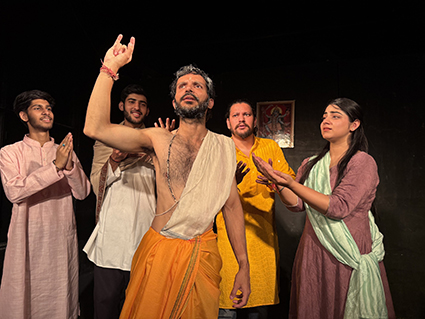
Jammu, July 5: Natrang presented a new Hindi play, ‘Ramkrishna Paramhans’, written by renowned playwright Sarveshwar Dayal Saxena and directed by Neeraj Kant, here today at Natrang Studio Theatre under its weekly theatre series, ‘Sunday Theatre’. On the occasion, Natrang Director Balwant Thakur said that it is Natrang’s constant endeavour to acquaint audiences with the lives and ideas of India’s great thinkers and philosophers who carried the essence of Indian ethos to the global stage. Through such presentations, Natrang seeks to showcase their inspiring journeys and bring India’s rich philosophical and cultural vision to the forefront. This production is a sincere step in that direction.
The play opened with the resonant sounds of temple bells, devotional chants, and the sacred invocation of the Divine Mother, instantly transporting the audience into an atmosphere of profound spirituality. Against this evocative backdrop unfolded the inspiring journey of Gadadhar, a simple village boy from Kamarpukur, who was destined to become one of India’s greatest spiritual luminaries, Sri Ramakrishna Paramhans. From his earliest years, Gadadhar was portrayed as an extraordinary child, deeply immersed in divine contemplation rather than worldly pursuits. His mystical experiences, including a moment of spiritual ecstasy while witnessing a flock of white cranes soaring across a dark monsoon sky, reflected the awakening of a soul already touched by the divine. As he matured, his yearning to realize God intensified, becoming the central force that shaped his life. The narrative gathered emotional and spiritual momentum when Gadadhar assumed the role of priest at the Kali Temple in Dakshineswar. There, his intense devotion and unwavering quest for the Divine Mother reached extraordinary heights. Through heartfelt prayers, tears of longing, and complete surrender, the play vividly depicted his spiritual struggle until he was ultimately blessed with the divine vision of Mother Kali, transforming him into Ramakrishna Paramhans, whose life became an embodiment of unconditional love and spiritual enlightenment. The play further explored Ramakrishna’s remarkable spiritual journey through various religious traditions. Under the guidance of different masters, he practised Tantra, Vedanta, Islam, and Christianity, ultimately realizing that all faiths lead to the same Supreme Truth. This timeless philosophy of religious harmony emerged as the central message of the production.
A significant dramatic dimension was added with the arrival of seekers and disciples, most notably the young and inquisitive Narendra Nath Dutta, who later became Swami Vivekananda. Through profound spiritual dialogues, compassion, and personal example, Ramakrishna transformed Narendra into a visionary leader destined to carry India’s spiritual heritage to the world. Even while enduring the agony of an incurable illness, Ramakrishna remained immersed in divine bliss. In the moving concluding sequences, he entrusted his disciples with the mission of serving humanity and spreading the message of universal brotherhood. The play culminated in a deeply moving realization that while the saint departed from the physical world, his teachings continue to illuminate humanity with the ideals of love, compassion, harmony, and spiritual awakening.
The production featured compelling performances by Kushal Bhat, Kananpreet Kaur, Aakash Wadhwan, Nikshay Mahajan, and Aryan Sharma, who brought the spiritual narrative alive with sincerity and conviction. The lighting design was executed by Neeraj Kant, while the evocative musical score was composed by Mehak Chib, both contributing significantly to the devotional ambience of the production. The play was ably presented before the audience by Mahikshit Singh. |
