news details |
|
|
| Two-week NCM-funded Mathematics school concludes at NIT Srinagar | | | 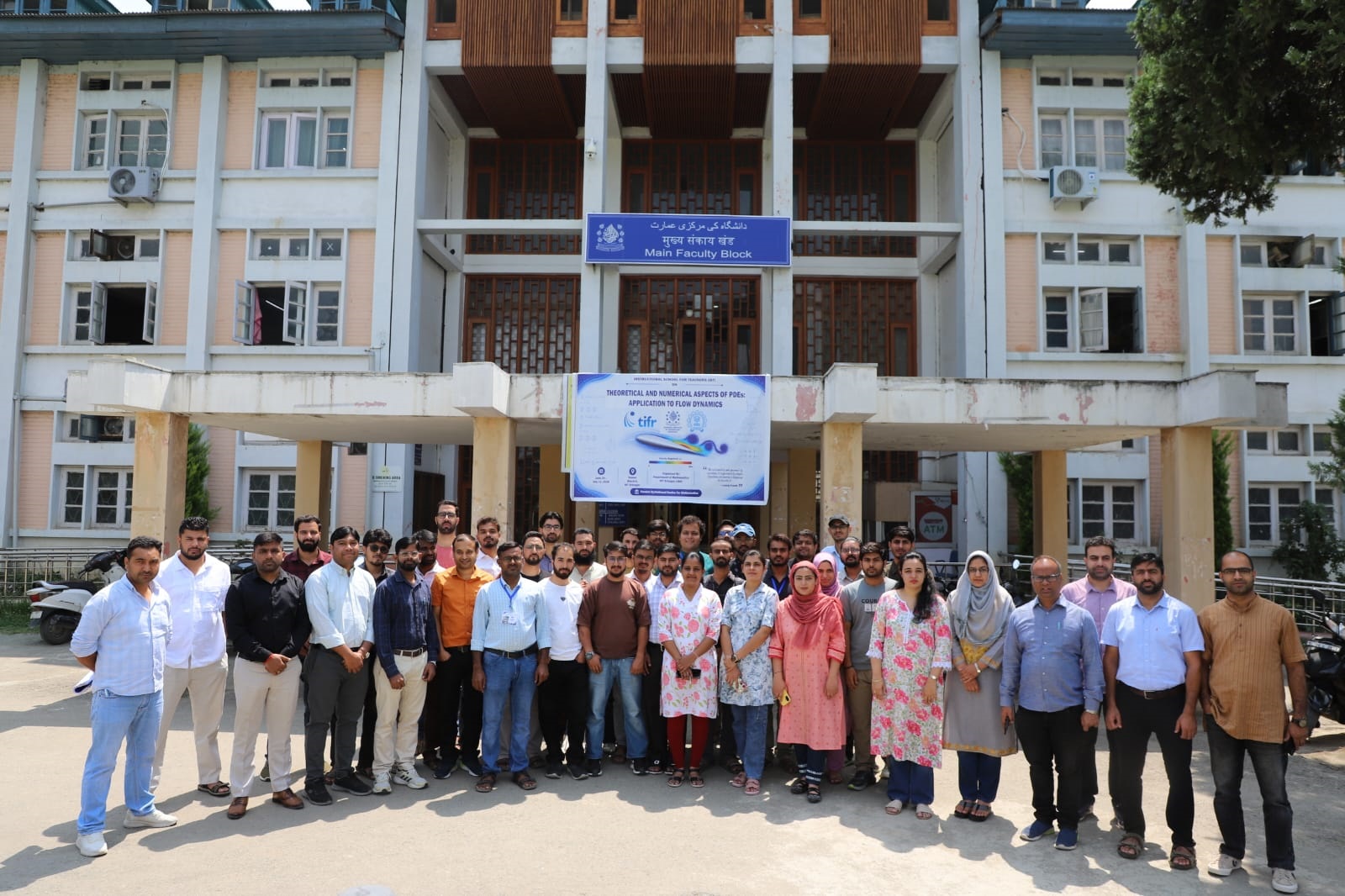 Early Times Report Early Times Report
Srinagar, July 11: A two-week Instructional School for Teachers (IST) on “Theoretical and Numerical Aspects of Partial Differential Equations: Applications to Flow Dynamics” concluded on Saturday at the National Institute of Technology (NIT) Srinagar.
The programme, held from June 29 to July 11, 2026, was organised by the Department of Mathematics, NIT Srinagar, with financial support from the National Centre for Mathematics (NCM), a joint centre of the Tata Institute of Fundamental Research (TIFR), Mumbai, and IIT Bombay.
The instructional school brought together 42 faculty members, researchers, and teachers from universities and higher educational institutions across the country for an intensive academic programme focused on the theoretical and numerical aspects of partial differential equations (PDEs) and their applications in flow dynamics.
The valedictory ceremony was marked by the distribution of certificates to all participants in recognition of their successful completion of the programme. Faculty members of the Department of Mathematics, including Dr. Mehraj Ahmad Lone, Dr. Rameez Raja, Dr. Mushtaq Ahmad Bhat, Dr. Owais Ahmad, Dr. Idrees Qasim, Dr. Saleem Yousuf, Dr. Bilal Ahmad Wani and Dr. Sivaramakrishnan, actively participated in the successful organisation of the programme.
Convener of the programme, Dr. Atendra Kumar, expressed satisfaction over the successful completion of the instructional school and thanked all participants for their active engagement.
“We are confident that the faculty members, students and research scholars who attended this programme will greatly benefit from the concepts, analytical methods and academic interactions they experienced here. These learnings will significantly contribute to their present and future research in applied mathematics and related disciplines,” he said. Dr. Atendra expressed gratitude to the National Centre for Mathematics (NCM) for sponsoring the programme and acknowledged the support extended by the Institute administration, the Department of Mathematics, organising team and all those who contributed to the successful conduct of the event.
He also thanked the distinguished resource persons for delivering high-quality lectures throughout the programme, including Prof. Muthukumar T (IIT Kanpur), Prof. Rajendra K. Ray (IIT Mandi), Dr. Tanmay Sarkar (IIT Jammu) along with tutorial instructors Mr. Arindam Sarkar (IIT Mandi) and Mr. Andleeb Hamid (NIT Srinagar), whose academic guidance and mentoring greatly enriched the learning experience.
Speaking on the occasion, Dr. Zamrooda Jabeen, Head, Department of Mathematics, congratulated the participants and appreciated their enthusiastic involvement throughout the two-week programme.
She said such academic initiatives provide an excellent platform for faculty members and researchers to strengthen their theoretical foundations while fostering collaboration with experts from premier institutions.
Participants praised the academic quality of the programme and the arrangements made by the organising team. Dr. Mohd Shuaib Akhtar from Aligarh Muslim University and Dr. Shyaman V. P. from Chettinad Institute of Technology (CARE), Tamil Nadu, among others, shared their positive feedback, describing the instructional school as academically enriching and highly beneficial for teaching and research.
In his message, Director, NIT Srinagar, Prof. Binod Kumar Kanaujia, congratulated the Department of Mathematics for successfully organising the national-level programme.
He said the institute remains committed to promoting high-quality academic activities that strengthen research culture, foster interdisciplinary collaboration and create opportunities for faculty and young researchers to engage with leading experts from across the country.
Registrar, NIT Srinagar, Prof. Atikur Rahman, appreciated the efforts of the organising committee and the resource persons for making the programme a success.
He said such instructional schools enhance academic excellence, facilitate knowledge exchange and contribute significantly to capacity building among teachers and researchers, in line with the institute’s vision of promoting quality higher education and research. |
|
|
|
|
|
|
|
|
|
|
|
|
| |
| |
|
|
|
|
 |
|
|
