 Early Times Report Early Times Report
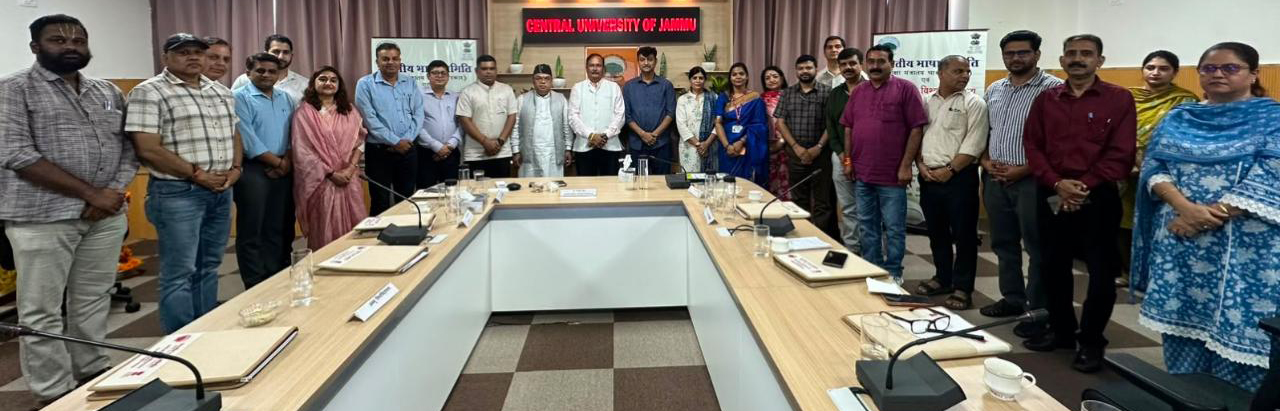
JAMMU, July 24: The Central University of Jammu, in collaboration with the Bharatiya Bhasha Samiti, Ministry of Education, Government of India, organized a State-Level One-Day Inception Meeting for the successful implementation of the Bharatiya Bhasha Pustak Yojana (Indian Language Book Scheme). The meeting was held under the esteemed chairmanship and guidance of Prof. Sanjeev Jain, Vice-Chancellor, Central University of Jammu.
In his inaugural address, Prof. Sanjeev Jain emphasized that language forms the foundation of society. He stated that the Bharatiya Bhasha Pustak Yojana would empower students by providing access to knowledge in Indian languages across diverse disciplines, thereby enriching their learning experience. He added that the initiative would not only contribute to building an Atma Nirbhar Bharat (Self-Reliant India) but also strengthen the country's education system in alignment with the objectives of the National Education Policy (NEP) 2020.
Delivering the keynote presentation during the inaugural session, Dr. Chandan Srivastava, Academic Coordinator, Bharatiya Bhasha Samiti, New Delhi, provided a comprehensive overview of the Bharatiya Bhasha Pustak Yojana and its implementation framework. He highlighted the vision of promoting higher education through Indian languages and discussed the objectives and operational strategies of the scheme. Stressing the importance of academic excellence, he elaborated on the significance of India's rich linguistic diversity, comprising 1,369 languages, the 22 languages included in the Eighth Schedule of the Constitution, and the vast number of speakers of Indian languages.
Dr. Srivastava explained that the scheme aims to ensure equitable access to quality education by making academic resources available in Indian languages. He discussed the three foundational pillars of the initiative-the National Education Policy (NEP) 2020, the Ministry of Education, Government of India, and the Union Budget 2025. He further outlined the key features of the scheme, including the development of original textbooks and translations, decentralized implementation, quality assurance mechanisms, transparent processes, defined timelines, digital systems, project-based funding, and content creation. He also informed the participants that both central and state-level action plans would be formulated to facilitate the effective implementation of the scheme, supported by technological interventions and a series of capacity-building workshops. |
