 Early Times Report Early Times Report
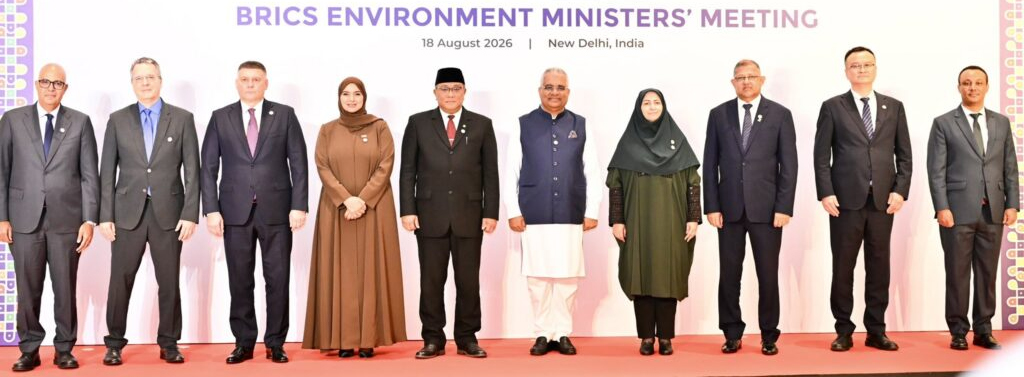
NEW DELHI, Aug 18: At the 12th BRICS Environment Ministers' Meeting under India's BRICS 2026 Chairship, Union Minister for Environment, Forest and Climate Change, Government of India, Bhupender Yadav, along with Heads of Delegations of BRICS member countries, unveiled four knowledge Compendiums prepared by the BRICS Environment Working Group. The documents reflect leading practices, knowledge systems and innovations amongst the BRICS Member Countries.
These Compendiums are the outcome of constructive and meaningful deliberations undertaken in the BRICS Environment Working Group, culminating in the development of four collaborative knowledge products. Together, they embody the spirit of cooperation and reflect the national experiences, leading practices, innovative solutions, and local knowledge systems of BRICS Member Countries.
Compendium on National Experiences, Leading Practices & Success Stories on Promoting Sustainable Lifestyles compiled under India's BRICS 2026 Chairship by the Ministry of Environment, Forest and Climate Change (MoEFCC), serves as a collective knowledge repository bringing together exemplary case studies from across BRICS Member Countries, including Brazil, China, Egypt, Ethiopia, India, Indonesia, South Africa, and the UAE.
The Compendium documents how BRICS Member Countries are translating the concept of sustainable lifestyles into practical action through policy innovation, behavioural change initiatives, environmental education, community participation, sustainable consumption and production, circular economy approaches, ecosystem restoration, clean energy transitions and green development programmes. India's contributions include Mission LiFE, the Environment Education Programme, the SAMBHAV Campaign, reflecting its whole-of-government and whole-of-society approach to citizen-led sustainable lifestyles.
Together, they show how individual choices, market supply shifts, and policy frameworks converge to drive systemic transformation. Ultimately, by emphasizing citizen ownership, context-driven solutions, and digital integration, the compendium provides an actionable blueprint for peer learning, joint research, and multilateral cooperation to advance environment friendly lifestyles.
Compendium on Best Practices and Innovative Approaches for Integrated Fire Management: Globally, changing climate conditions, prolonged droughts and rising temperatures are increasing the frequency and intensity of wildfires, putting ecosystems, biodiversity, livelihoods and communities at risk. Recognising this shared challenge, India, under its BRICS Chairship 2026, brought Integrated Wildfire Management to the forefront of international cooperation. The journey brought together countries to share experiences, innovative solutions and practical approaches from community-led prevention and indigenous knowledge to early warning systems, technology, preparedness and coordinated response for Integrated Wildfire Management.
One of the outcomes is the Compendium on "Best Practices and Innovative Approaches for Integrated Wildfire Management." More than a collection of country experiences, the Compendium reflects a shared vision: from prevention to preparedness, from early warning to early action, and from response to recovery- we must manage fire together. By connecting knowledge, technology, institutions and communities, BRICS countries can strengthen collective resilience, protect forests and biodiversity, safeguard livelihoods, and build a more fire-resilient future. |
