news details |
|
|
| Chief Secretary reviews UNDP strategy for SDG-linked budgeting in J&K | | | 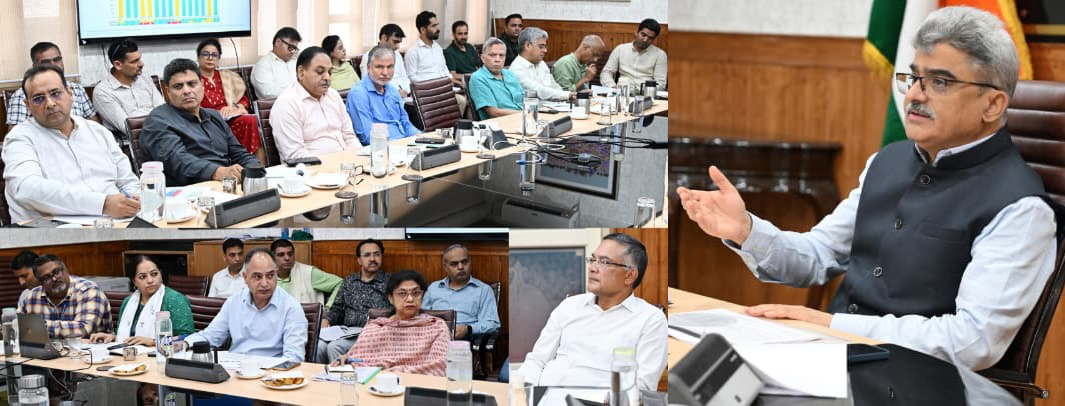 Early Times Report Early Times Report
SRINAGAR, Aug 19: Chief Secretary, Atal Dulloo, today chaired a meeting to assess the strategy proposed by the United Nations Development Programme (UNDP) for aligning the annual budget of Jammu & Kashmir with the Sustainable Development Goals (SDGs), with emphasis on outcome-based planning, convergence of schemes and evidence-based allocation of public resources.
The meeting was attended by Additional Chief Secretary, Finance; Commissioner Secretary, Information Technology; Commissioner Secretary, Social Welfare; Secretary, Agriculture; Director Planning, besides senior officers and representatives of various departments.
The UNDP team made a detailed presentation to provide a preliminary roadmap for aligningpublic expenditure with the Sustainable Development Goals, outlining a structured approach for integrating SDGs into the budgeting and public financial management architecture of the Union Territory.
Taking note of the strategy presented by UNDP, the Chief Secretary directed the Planning Department to constitute a dedicated team to work in close coordination with the UNDP team and formulate a comprehensive roadmap identifying the interventions required under each SDG for achieving the desired targets over the coming years.
He emphasised the need to undertake a comprehensive mapping of Centrally Sponsored Schemes and UT Government schemes against the respective SDGs so that the contribution of each scheme towards individual goals and targets is clearly established. He further called for identifying the additional interventions and resource requirements that may be necessary to bridge existing gaps and accelerate progress towards the identified targets.
The Chief Secretary stressed that achievement of the SDGs cannot be confined to individual departments or isolated schemes, as several goals require cross-cutting interventions and coordinated action across multiple sectors. He called for leveraging existing schemes and programmes while simultaneously assessing the requirement for additional funding under appropriate budgetary provisions.
He further directed that the exercise should identify the targeted population and beneficiaries for various interventions so as to facilitate focused implementation and measurable outcomes. He laid emphasis on convergence of schemes, coordinated implementation and outcome-based monitoring over a defined period of time.
The Chief Secretary's directions are aimed at moving the exercise beyond a simple tagging of budgetary allocations and towards preparation of a practical, time-bound and results-oriented action plan for achieving SDG targets in Jammu & Kashmir.
On this occasion the Additional Chief Secretary, Finance, Shailendra Kumar, emphasised the need for assigning a clear role to every scheme in achieving the respective SDG targets.
He called for mapping each scheme against the relevant SDG and assessing its contribution towards the concerned goal, including the extent of contribution that can reasonably be achieved on the ground. Such an exercise, he observed, would provide greater clarity on what needs to be done, where the intervention is required and within what timeframe.
He also stressed the importance of capacity building of officers and departmental functionaries alongside preparation of the SDG-aligned budgeting framework to ensure that the proposed system is implemented effectively at the operational level.
The ACS Finance further called for initiating the exercise immediately so that its early benefits could be realised and the necessary framework incorporated into the next year's budgetary exercise by the concerned departments.
The UNDP proposal envisages a three-year programme aimed at integrating SDGs into the budgeting and public financial management systems of Jammu & Kashmir. The proposed framework seeks to establish a direct linkage between budgetary inputs, departmental outputs, measurable outcomes and SDG targets, thereby enabling more informed decisions on allocation and utilisation of public resources. |
|
|
|
|
|
|
|
|
|
|
|
|
| |
| |
|
|
|
|
 |
|
|
