 Early Times Report Early Times Report
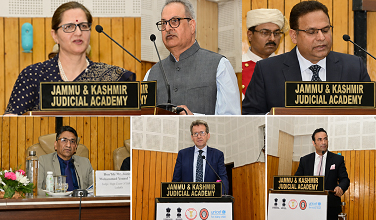
SRINAGAR, Sept 5: The Juvenile Justice Committee, High Court of Jammu & Kashmir and Ladakh, with the support of UNICEF India, organized a one day annual consultation on "Juvenile Justice (Care and Protection of Children) Act, 2015: A Decade of Implementation and the Way Forward" at the J&K Judicial Academy, Mominabad, Srinagar.
The consultation was attended by the Judges of the High Court, Judicial Officers, Principal Magistrates of Juvenile Justice Boards, Chairpersons of Child Welfare Committees, officers of Special Juvenile Police Units, senior officers of concerned departments, Legal Services Authorities, child protection professionals, mental health experts, civil society and academia besides participants joining virtually from Jammu and Ladakh. The consultation reviewed a decade of implementation of the Juvenile Justice Act and identified priorities for strengthening the Juvenile Justice and Child Protection System.
Justice Sindhu Sharma, Judge, High Court of J&K and Ladakh and Chairperson, Juvenile Justice Committee, in her presidential address, emphasized that a child in conflict with law remains, first and foremost, a child and that the juvenile justice system must remain rooted in fairness, rehabilitation and the developmental needs of children, in keeping with principles reflected in the Beijing Rules. She highlighted the continuing challenge of balancing the reformative approach with concerns arising from serious offences. She stressed the need for adequately resourced institutions, trained personnel, effective data systems and accountability. She observed that while the first decade focused substantially on building the institutional architecture of juvenile justice, the next decade must focus on ensuring that these institutions deliver meaningful, child-centered outcomes and provide every child with dignity, rehabilitation and a genuine opportunity for a better future.
Justice Mohd. Akram Chowdhary, Judge, High Court of J&K and Ladakh and Member, Juvenile Justice Committee, described the completion of ten years of the Act as an opportunity to objectively assess its implementation. While acknowledging the functioning of Child Welfare Committees and Juvenile Justice Boards across J&K and Ladakh, he emphasized that success must ultimately be measured by its impact on children. He called for stronger infrastructure, trained personnel, continuous capacity building, adequate administrative and financial support, periodic evaluation and improved inter-departmental coordination.
Justice Wasim Sadiq Nargal emphasized that juvenile justice extends beyond law and requires a multidisciplinary approach. Reflecting on a decade of the Juvenile Justice Act, he stressed the need to address implementation gaps and strengthen delivery on the ground. He highlighted the concerns regarding children above sixteen years accused of heinous offences, confidentiality of juvenile records and effective functioning of Juvenile Justice Boards and Child Welfare Committees. He also called for child-centric adoption, adequate infrastructure, trained personnel and administrative support, stressing that the Act must be implemented in letter and spirit to ensure protection, rehabilitation, dignity and hope for every vulnerable child. |
