 Sanjay Pandita Sanjay Pandita
Early Times Report
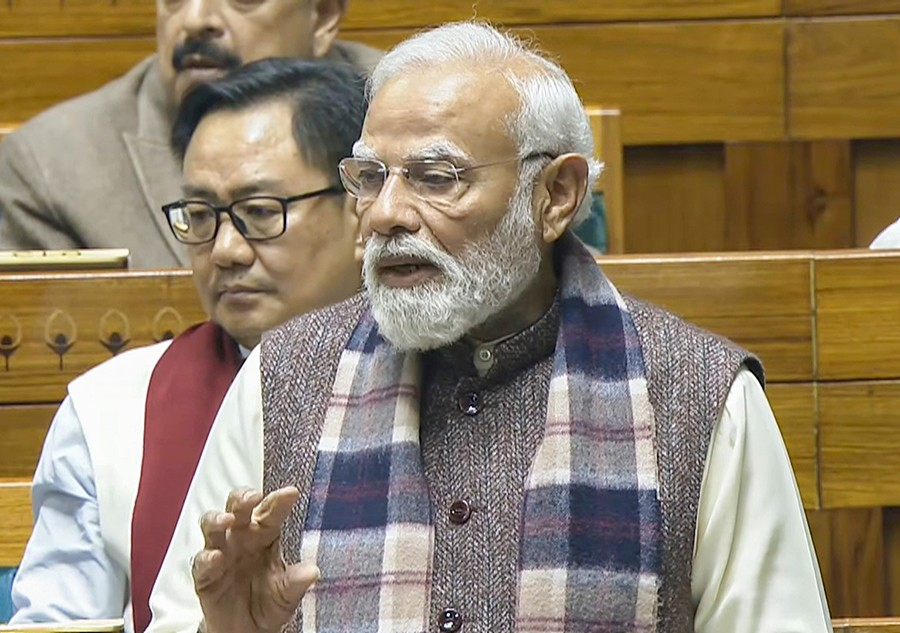
Jammu, Dec 8: Prime Minister Narendra Modi on Monday described Vande Mataram as a powerful source of inspiration for building an Atmanirbhar Bharat and a prosperous India, as he opened the discussion in the Lok Sabha marking the 150th anniversary of the national song.
Launching a sharp political attack, Modi alleged that former Prime Minister Jawaharlal Nehru removed certain lines from the 1870 version of the song to appease the Muhammad Ali Jinnah–led Muslim League.
“Under pressure, the Congress divided Vande Mataram. And because of this weakness, the Congress ultimately divided the nation as well,” Modi said, adding that the Indian National Congress has now transformed into what he termed the “Muslim League–Congress (MLC).”
Modi reflected on the enduring legacy of Vande Mataram, calling it an “unrivalled literary work in world history” and a defining force of India’s freedom movement. He said the 150-year celebration is not just a remembrance of the past but a “continuous source of strength and motivation.” He ended his address by chanting Vande Mataram thrice.
“Our forefathers dreamt of an independent India; today’s youth dream of a prosperous India. The spirit of Vande Mataram guided the struggle for freedom, and it will now guide the journey toward national prosperity,” he said.
Tracing the song’s evolution, Modi said Vande Mataram shaped the nation’s character and strengthened its resolve through challenges. “When India faced crises, it marched ahead with the spirit of Vande Mataram. After 1947, our priorities changed, but the song’s relevance never dimmed.”
Citing various historical moments, Modi said the collective spirit expressed in Vande Mataram played a decisive role during food shortages, wars, External threats, and even the Emergency.
“It was this very spirit that helped the nation stand tall again whenever its democratic values were challenged,” he said.
He linked India’s modern national goals — including Viksit Bharat 2047 and Atmanirbhar Bharat — to the ideals embedded in the song. Modi also recited the stanza that was omitted from the official version. Initially referring to the poet Bankim Chandra Chattopadhyay as “Bankim da,” he later used the more formal “Bankim babu.”
“Vande Mataram embodies the power of this nation — its culture, its development, and its prosperity,” he said, adding that the anthem continues to energize India's pursuit of self-reliance and global prominence.
The Prime Minister highlighted the song’s spiritual and motivational essence, especially during the freedom struggle. First published in a magazine in 1875 and later included in Bankim Chandra’s novel Anandamath in 1882, Vande Mataram was conceptualized as a counter to British efforts to impose their own anthem in colonial India.
Modi said the song revived ancient Indian philosophies and reintroduced the idea of India as the divine mother.
“It was not merely a political slogan against British rule; it reawakened the cultural identity of a civilisation thousands of years old,” he said. He also noted that Bankim’s depiction of Bharat Mata showcased India as both a goddess of knowledge and prosperity and as Maa Chandi, the fierce protector against injustice.
According to Modi, these powerful images inspired countless Indians to fight not for land or power, but to break the chains of slavery and resurrect India’s ancient heritage.
Modi questioned why a song that Mahatma Gandhi himself wished to designate as the national anthem had to face what he called “historic injustice.” He alleged that when the Muslim League objected to Vande Mataram, Jawaharlal Nehru, instead of standing firm, chose to concede.
He claimed Nehru even wrote to Subhas Chandra Bose, arguing that the song could provoke Muslims.
“A meeting was held in Bankim’s own Bengal to assess the utility of Vande Mataram. While the entire country opposed any dilution, the Congress compromised under pressure,” Modi said, linking the decision to the politics of appeasement. |
