 Early Times Report Early Times Report
Jammu, Dec 30: On June 6, 2025 when Prime Minister Narendra Modi inaugurated the historic Udhampur–Srinagar–Baramulla Rail Link, it was a landmark moment for Jammu and Kashmir.
The Udhampur–Srinagar–Baramulla Rail Link is the largest and most transformative infrastructure project completed in the Union Territory in 2025. The long-awaited rail corridor has finally connected the Kashmir Valley with the rest of the country through an all-weather railway network, ending a wait of more than seven decades.
The inauguration marks the culmination of decades of planning, engineering challenges, and sustained investment aimed at overcoming the region’s difficult terrain and harsh climatic conditions. With the commissioning of the final stretch, Kashmir has been seamlessly integrated into the national railway grid, providing a reliable alternative to road and air travel that were often disrupted due to weather and security concerns. Affordable and dependable rail connectivity has emerged as a safer and more economical option for students, workers, traders, and tourists alike. The new route is expected to reduce the Valley’s dependence on the Srinagar–Jammu National Highway, which frequently remains closed during winter due to snowfall and landslides, causing shortages and price hikes.
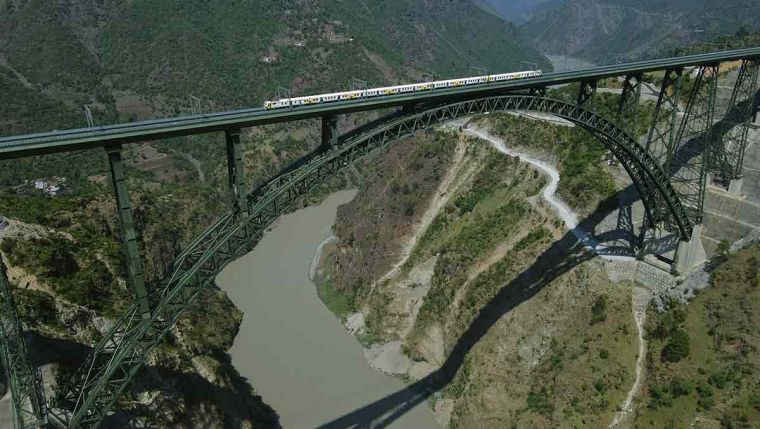
The Udhampur–Baramulla Rail Link is widely regarded as one of the most ambitious railway projects undertaken in independent India. The corridor includes world-class engineering feats such as the Chenab Rail Bridge, the world’s highest railway arch bridge, as well as the Anji Khad Bridge and a network of long tunnels cutting t The Udhampur–Srinagar–Baramulla Rail Link is the largest and most transformative infrastructure project completed in the Union Territory in 2025.
The long-awaited rail corridor has finally connected Kashmir with the rest of the country through an all-weather railway network, ending a wait of more than seven decades.
The inauguration marked the culmination of decades of planning, engineering challenges, and sustained investment aimed at overcoming the region’s difficult terrain and harsh climatic conditions.
Kashmir has been seamlessly integrated into the national railway grid, providing a reliable alternative to road and air travel that were often disrupted due to weather and security concerns.
Beyond connectivity, the project is expected to have far-reaching economic and social impacts. Improved access is likely to give a major boost to tourism, horticulture, handicrafts, and small-scale industries, while also creating new employment opportunities. Faster and cheaper transportation of apples, saffron, dry fruits, and other local produce to markets across the country is expected to enhance farmers’ incomes and reduce wastage.
Addressing the gathering at the inauguration ceremony, Prime Minister Modi described the rail link as a symbol of progress, unity, and development, stating that it reflects the government’s commitment to bringing modern infrastructure to every corner of the country. He said the project would open new avenues of opportunity for the youth of Jammu and Kashmir and strengthen the region’s integration with the national economy.
Security officials and policymakers have also highlighted the strategic importance of the rail corridor, noting that improved connectivity will enhance mobility, disaster response, and logistical support in the region.
With the completion of the Udhampur–Srinagar–Baramulla Rail Link, Jammu and Kashmir has entered a new phase of growth and transformation. The project stands not only as an engineering milestone but also as a powerful symbol of resilience and long-term development, reshaping the economic and social landscape of the Union Territory for generations to come. |
