| Chief Secretary Ashish Kundra chairs review meeting of Finance, Planning, Estate Departments in Leh | | | 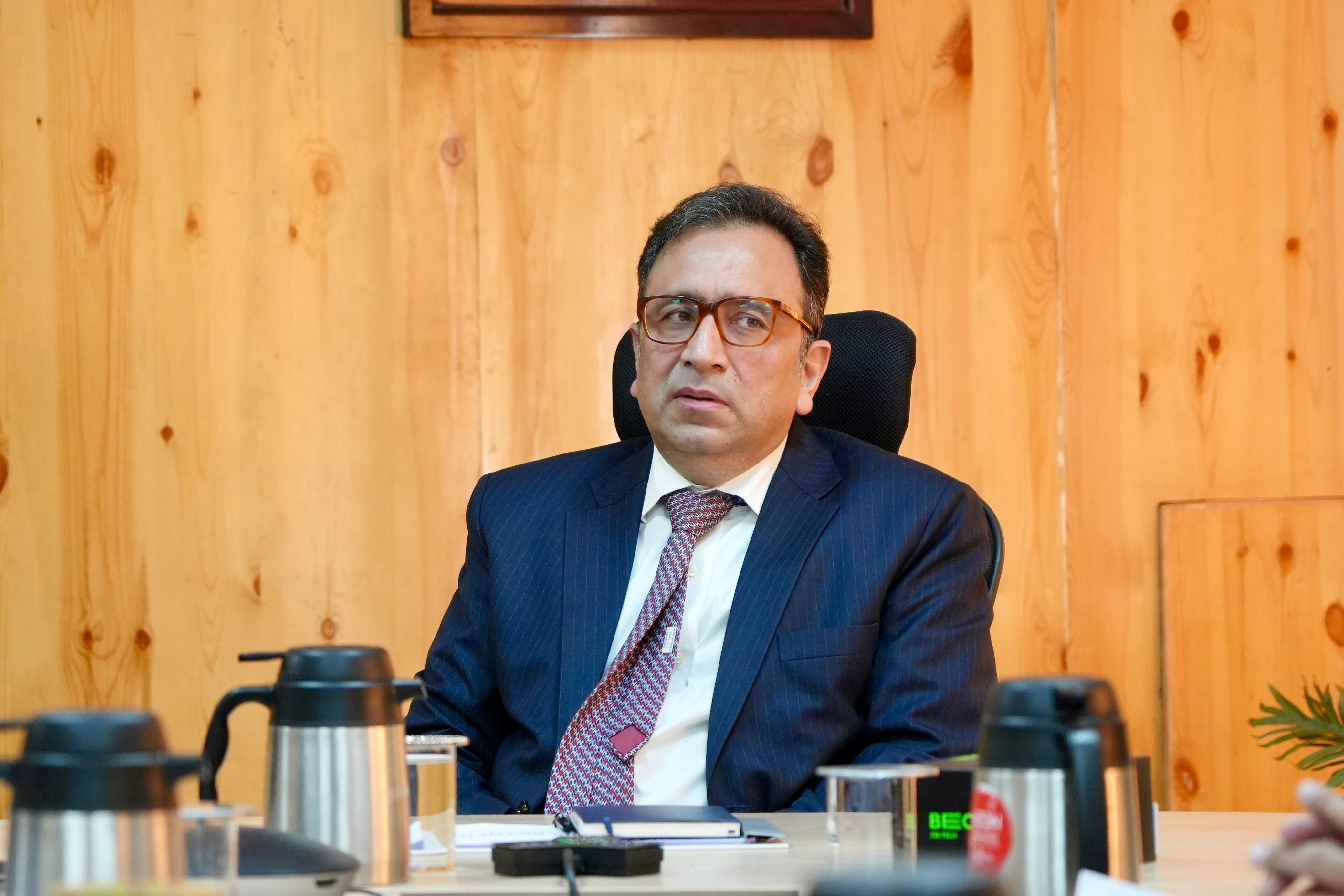
early times report
Leh, Jan 8: Chief Secretary of the Union Territory of Ladakh, Ashish Kundra, today chaired a departmental review meeting of the Finance Department, Planning, Development and Monitoring Department, and the Estate Department at Leh.
The meeting focused on financial planning, budgetary allocations, revenue augmentation strategies and institutional strengthening of key departments.
During the meeting, Ms. Kaneez Fatima, Joint Director, Finance Department, gave a detailed presentation covering revised estimates for FY 2025–26 and budget estimates for FY 2026–27, expenditure position as on 31.12.2025, and the format of PIB/DIB memoranda for appraisal of projects.
The presentation also included additional funds sought under RE 2025–26 following pre-budget discussions, object head-wise budget details under Demand No. 55 (revenue component), budget allocation of LAHDC Leh under both revenue and capital components, and the Special Development Package (SDP) revenue component.
Further, the Finance Department shared data on tax and non-tax revenue for the last five financial years, year-wise revenue collection of the Excise Department, sanctioned strength of the Finance Department of UT Ladakh, details of posts under Excise and Taxation, department and cadre-related issues, and the need to strengthen the opinion advisory role of the Finance Department. Trends related to LAHDC budget BE and RE since 2020 and the year-wise status of LAHDC posts up to 2025–26 were also reviewed.
The Planning, Development and Monitoring Department presented its organizational setup, sanctioned strength of ministerial and statistical staff, and details of the Directorate of Economics and Statistics. The department also briefed the Chief Secretary on department-wise allocation under the State Sector (CAPEX) for 2025–26, the Vibrant Village Programme and the Border Area Development Programme (BADP).
While reviewing the presentations, the Chief Secretary stressed the importance of effective grant-in-aid expenditure, particularly for tourism and social sectors, and emphasized object-wise review of allocations to avoid under-provisioning. He highlighted the need for a flexible fund at the district level to enable Deputy Commissioners to meet urgent requirements during field visits, especially in cases of shortages of essential commodities, with on-the-spot sanctioning mechanisms.
The Chief Secretary directed that a clear, standardized and transparent format be designed for fund appraisal and approval processes to avoid mechanical exercises and ensure ease of reference. He also reviewed the delegation of financial powers, professional services, SDP capital expenditure, PMFS–LFMS integration, Treasury Office functioning and CSS payment systems. The Finance Department was instructed to closely coordinate with the IT Department for department-wise CSS payment data and to establish a State Budget Cell to track CSS performance, spending and unspent balances using analytical tools and graphical dashboards in a systematic manner. |
|
