 Early Times Report Early Times Report
JAMMU/NEW DELHI, Jan 19: Kashmiri Pandit Holocaust Day was observed today by Panun Kashmir at multiple locations across Jammu, including Purkhoo Camp, Muthi Camp, Butanagar Camp and other areas inhabited by the exiled community. The observances are part of Panun Kashmir’s decision to mark the entire month of January as Jatividhwans Month, dedicated to remembrance, resistance to denial, and assertion of historical truth.
At the camp-level programmes, participants paid homage to the victims of the genocide and reflected on the circumstances that led to the mass exodus of Kashmiri Pandits. Speakers emphasised that the continuing condition of exile and denial of justice demonstrates that genocide is not a closed historical event but a continuing crime until accountability, restitution, and a secure homeland are achieved.
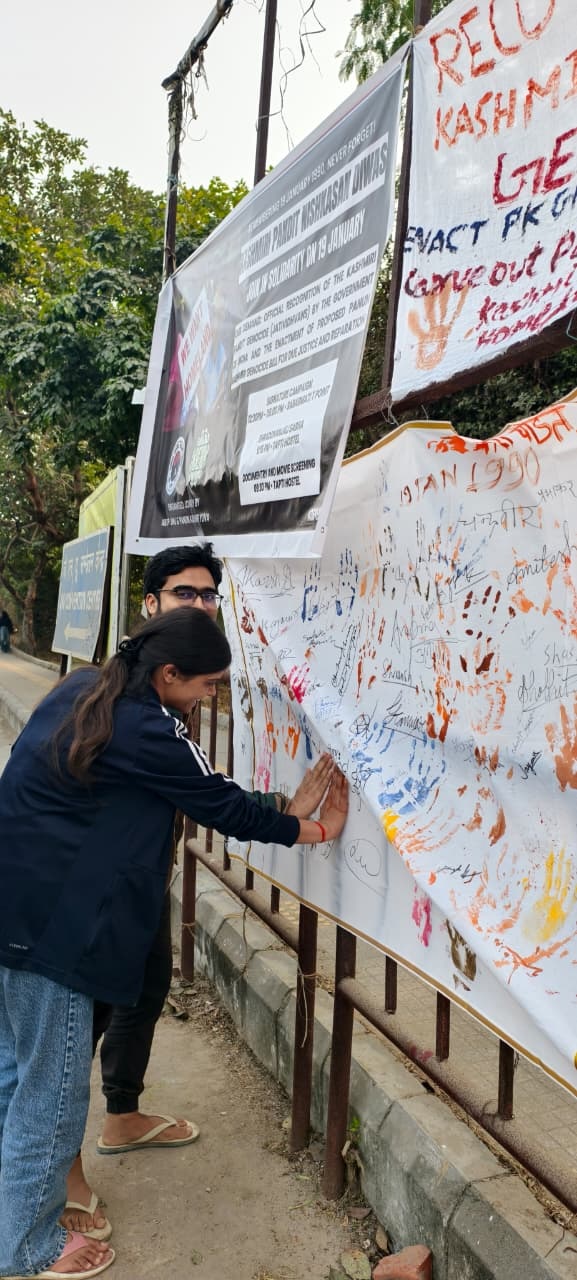
In New Delhi, Panun Kashmir organised an academic and public outreach programme at Jawaharlal Nehru University, where a signature campaign was conducted as part of the Holocaust Day observance. The campaign raised two principal demands: formal recognition of the Kashmiri Pandit genocide and enactment of Panun Kashmir’s Genocide and Atrocities Prevention Bi-2020. Students, research scholars, faculty members, and civil society participants actively endorsed the demands and engaged in discussions on genocide studies, constitutional responsibility, and the urgent need for a comprehensive domestic legal framework.
Participants noted that despite India being a signatory to the UN Genocide Convention, the absence of a domestic genocide law has enabled denial and impunity. The Genocide and Atrocities Prevention Bill - 2020, drafted by Panun Kashmir, was described as a holistic legislative framework addressing prevention, early warning mechanisms, punishment of perpetrators, victim protection, restitution, and rehabilitation, while also articulating the Indic civilisational understanding of Jatividhwans
Meanwhile, in Jammu, Kuldeep Raina, General Secretary of Panun Kashmir, speaking on a podcast in connection with Holocaust Day and Jatividhwans Month, stated. “The demand for recognition of the Kashmiri Pandit genocide and enactment of the Genocide and Atrocities Prevention Bill-2020 is fundamental to justice. Without a domestic law, genocide remains morally condemned but legally unaddressed. Recognition and legislation are not symbolic, they are constitutional and civilisational imperatives.”
He further emphasised that student participation at JNU reflects a growing societal refusal to accept erasure and denial. “When universities and young citizens insist on naming genocide and demanding accountability. they reinforce the ethical foundations of the Republic,” he added
Panun Kashmir reiterated that the month-long observances, including the JNU signature campaign, aim to institutionalise remembrance, counter narratives of dilution, and advance the community’s long-standing demands for legal recognition of genocide, enactment of a comprehensive prevention law, accountability of perpetrators, and a dignified, durable resolution rooted in justice and homeland. |
