 Early Times Report Early Times Report
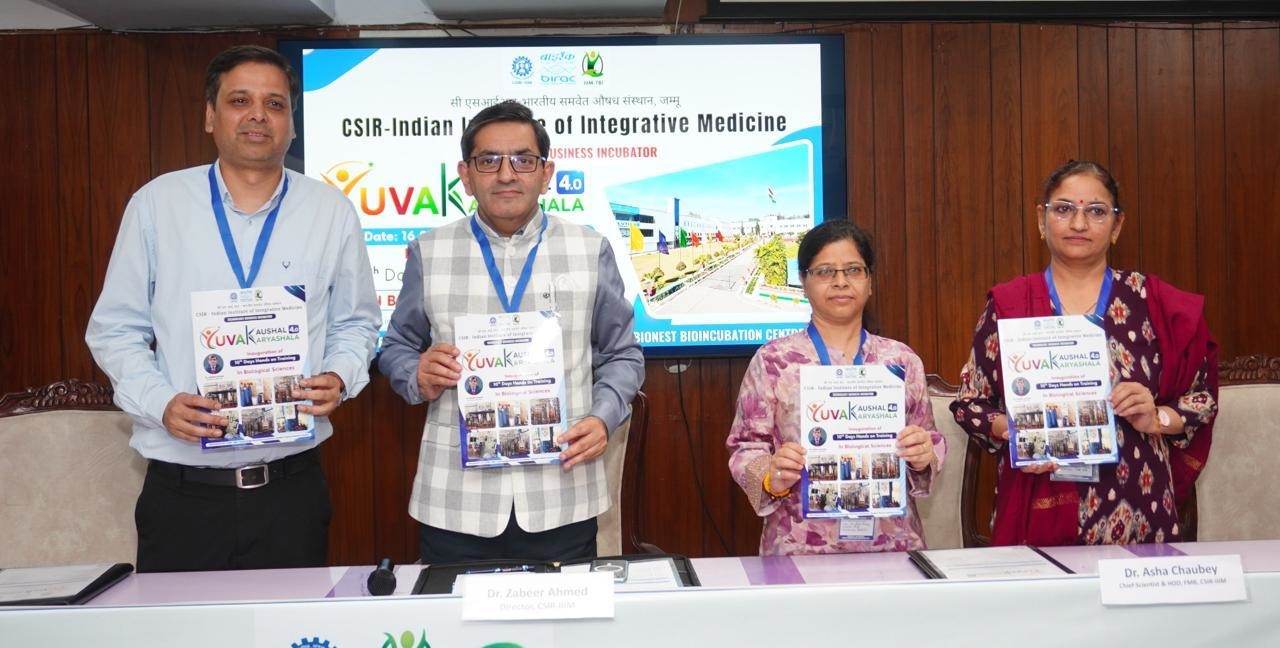
Jammu, May 16: The CSIR-Indian Institute of Integrative Medicine through its Technology Business Incubator (TBI) and BioNEST Bioincubation Centre on Saturday inaugurated “Yuva Kaushal Karyashala 4.0”, a 10-day hands-on training programme in Biological Sciences aimed at equipping students with practical scientific skills, exposure to industrial biotechnology infrastructure and orientation towards innovation-driven entrepreneurship.
The programme, launched at the institute’s Jammu campus, has brought together 31 participants, largely students from the School of Biotechnology, University of Jammu, for advanced practical training in areas including fermentation technology, microbial biotechnology, analytical instrumentation, startup incubation and pilot-scale scientific operations.
The inaugural session also witnessed the formal release of the “Yuva Kaushal Karyashala 4.0” training manual, which outlines the structure and practical modules of the workshop.
Addressing the participants, Dr Zabeer Ahmed, Director, CSIR-IIIM Jammu, described the students as “the future of the nation” and stressed that India’s scientific progress would depend heavily on creating a skilled and innovation-oriented youth population.
He said programmes like Yuva Kaushal Karyashala are essential for bridging the long-standing gap between theoretical classroom learning and practical laboratory exposure.
Linking the initiative with the national visions of Viksit Bharat 2047 and Atmanirbhar Bharat, Dr Ahmed said India’s biotechnology and research ecosystem requires trained manpower capable of working in real industrial and scientific environments.
He emphasised that exposure to high-end scientific infrastructure at an early stage can significantly shape the research mindset of students.
Highlighting the institute’s journey, Dr Ahmed said CSIR-Indian Institute of Integrative Medicine, established in 1941, has evolved into one of the country’s leading multidisciplinary research institutions, contributing extensively in pharmaceuticals, natural products, fermentation technology, medicinal plants and biotechnology innovation.
He encouraged the students to make full use of the institute’s advanced facilities, including large-scale fermentation systems with capacities extending up to 25,000 litres, and interact closely with scientists, technical experts and innovators working across various disciplines.
He urged students to remain focused on research and assured them that CSIR-IIIM would continue supporting young innovators and startup aspirants. |
