 Early Times Report Early Times Report
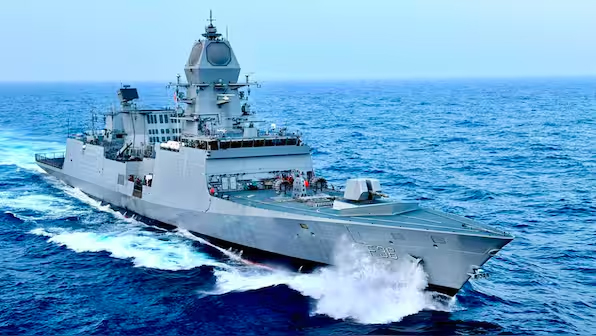
Jammu, June 21: Prime Minister Narendra Modi on Sunday asserted that India's rise as a global power is closely linked to its maritime strength, as he commissioned three indigenously built naval platforms—INS Agray, INS Dunagiri and INS Sanshodhak—into the Indian Navy at a ceremony held in Kolkata.
Addressing the gathering, the Prime Minister said the induction of the three vessels marks another significant milestone in India's journey towards self-reliance in defence manufacturing and maritime capability.
He noted that the commissioning coincided with International Yoga Day and World Hydrography Day, making the occasion even more significant, especially with the induction of INS Sanshodhak, described as India's most advanced hydrographic survey ship.
Congratulating the Indian Navy, scientists, engineers, workers and all those associated with the projects, Modi said the three ships symbolize India's commitment to Atmanirbhar Bharat, Surakshit Bharat, and Viksit Bharat.
The Prime Minister emphasized that maritime power has become a critical determinant of economic growth, national security, and global influence in the 21st century.
He pointed out that most of the world's trade moves through sea routes, while undersea infrastructure carries global data networks.
Emerging sectors such as deep-sea resources, critical minerals, and new energy sources are also increasingly linked to maritime domains, he added.
Referring to the commissioning of the indigenous aircraft carrier INS Vikrant in recent years, the Prime Minister said India had opened a new chapter in maritime history and demonstrated its growing capabilities before the world. The induction of INS Agray, INS Dunagiri and INS Sanshodhak, he said, further strengthens that trajectory.
Highlighting India's progress in defence manufacturing, Prime Minister said the newly commissioned ships were designed and built in the country with the contribution of Indian industries, engineers and workers.
He reiterated that India no longer wants to remain merely a buyer of defence equipment but aims to emerge as a leading manufacturer and exporter.
The Prime Minister stated that over 40 indigenously built warships and submarines have been inducted into the Indian Navy in recent years, while another 45 major naval platforms are currently under construction. This, he said, reflects India's expanding industrial capabilities and technological advancement.
Underscoring the employment potential of the maritime sector, Modi described it as a major engine of economic growth and job creation.
He noted that more than 200 Micro, Small and Medium Enterprises (MSMEs) contributed to the construction of the three naval platforms commissioned on Sunday, generating significant employment opportunities across various sectors.
The Prime Minister said the government has launched a comprehensive strategy to strengthen India's maritime ecosystem through policy reforms, increased domestic manufacturing, shipbuilding, ship repair, ship recycling and maintenance, repair and overhaul (MRO) facilities.
Referring to the recently announced Rs 70,000-crore incentive package for the shipping sector, Mr. Modi said the initiative is aimed at strengthening India's maritime future and accelerating industrial growth.
He also highlighted ongoing efforts to modernize ports, expand waterways, improve logistics infrastructure and enhance coastal connectivity under initiatives such as the Sagarmala programme. These measures, he said, are helping reduce logistics costs, boost industrial growth and create economic opportunities in coastal regions.
On defence self-reliance, Modi said India has made remarkable progress since 2014. He noted that the country's defence production has increased from around Rs 40,000 crore before 2014 to nearly Rs 1.8 lakh crore today. Similarly, defence exports have surged from approximately Rs 700 crore to nearly Rs 40,000 crore, with Indian-made defence equipment now reaching more than 80 countries.
The Prime Minister said the achievements demonstrate the transformative impact of clear policies, focused implementation and collective national effort, though much more remains to be accomplished.
Recalling Bengal's historic maritime legacy, Modi said the state has played a pivotal role in India's trade and maritime connections for centuries. He noted that Kolkata's Syama Prasad Mookerjee Port bears the name of the country's first Industry Minister and a prominent son of Bengal.
Expressing confidence in West Bengal's future role, Modi said the state possesses the port infrastructure, industrial capacity, skilled workforce and strategic location necessary to emerge as a major hub of India's Blue Economy, maritime manufacturing, logistics and coastal development.
Stressing that India views the oceans as a medium of cooperation while recognizing the importance of strength in preserving peace, the Prime Minister said national security is essential for protecting prosperity, and self-reliance is crucial for shaping the future.
He described INS Agray, INS Dunagiri and INS Sanshodhak as symbols of a confident and self-reliant India that is increasingly asserting its capabilities on the global stage.
The Prime Minister concluded by extending his best wishes to the Indian Navy and congratulating all scientists, engineers, workers and citizens associated with the successful commissioning of the three indigenous naval platforms. |
