|
|
| Breaking News : |
|
|
 |
Photo Gallery |
 |
|
|
|
| |
news details |
|
|
| Ram Madhav’s return signals renewed BJP focus on J&K | | | 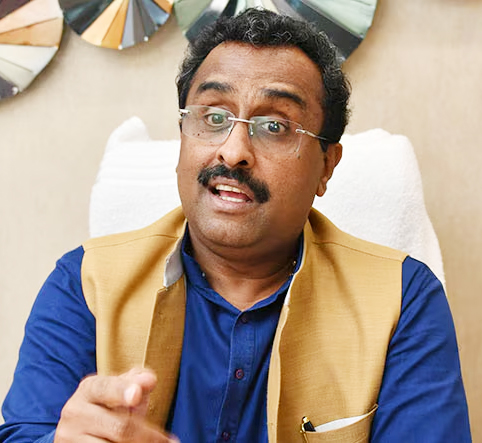 Sanjay Pandita Sanjay Pandita
Early Times Report
Jammu, Aug 20: The appointment of veteran BJP leader Ram Madhav as a national vice president of the Bharatiya Janata Party is being viewed as a significant organisational move, particularly in the context of Jammu and Kashmir, where he has played a crucial political and electoral role for the party.
BJP national president Nitin Nabin on Monday announced a new team of national office-bearers, appointing Madhav among 13 national vice presidents. The reshuffle brings the former national general secretary back into a key organisational position after several years.
Madhav's elevation has generated considerable interest in Jammu and Kashmir because of his long association with the BJP's political strategy in the Union Territory. Party circles believe his return to a prominent organisational role could indicate a renewed focus on Jammu and Kashmir, where the BJP has emerged as a major political force.
Madhav was the BJP's national general secretary in charge of Jammu and Kashmir during the 2014 Assembly elections. The election produced a fractured mandate, with the People's Democratic Party winning 28 seats and the BJP emerging as the second-largest party with 25 seats in the 87-member Assembly.
The fractured verdict presented an unusual political challenge, with the PDP dominant in the Valley and the BJP securing most of its seats in the Jammu region. Madhav subsequently played a key role in negotiations that culminated in the PDP-BJP alliance government in 2015.
The alliance was politically significant as it brought together two parties with substantial ideological and regional differences. The government headed by PDP founder Mufti Mohammad Sayeed was sworn in on March 1, 2015, with BJP leader Nirmal Kumar Singh as Deputy Chief Minister. It marked the first time the BJP became a coalition partner in the government of Jammu and Kashmir.
Madhav himself later described the 2014 mandate as a peculiar political situation in which the two parties had to come together to avoid another spell of Governor's Rule and another election. He was widely regarded as one of the principal BJP strategists involved in forging the alliance.
His association with Jammu and Kashmir did not end with the collapse of the PDP-BJP government in 2018. In June that year, Madhav announced the BJP's decision to withdraw from the alliance, bringing the coalition government to an end.
Madhav returned to the centre of BJP's Jammu and Kashmir strategy ahead of the 2024 Assembly elections. After the Election Commission announced the poll schedule, the BJP appointed him, along with Union minister G Kishan Reddy, as election in-charges for the Union Territory.
The move was significant because it marked Madhav's return to active electoral politics after his earlier stint as BJP national general secretary. During the 2024 elections, he was closely involved in the party's campaign and organisational strategy. The BJP eventually won 29 of the 90 Assembly seats, emerging as the second-largest party, with all its victories coming from the Jammu region.
Against this backdrop, his appointment as national vice president is likely to attract particular attention in Jammu and Kashmir. While the BJP has not officially stated that Madhav's new position is specifically linked to the Union Territory, his political experience there makes him an important asset for the party as it works to consolidate its position.
His elevation also comes at a time when Jammu and Kashmir's political landscape remains in transition following the 2024 Assembly elections. The BJP has retained a strong base in the Jammu region while continuing to explore ways of expanding its political footprint across the Union Territory.
For the BJP, Madhav brings a combination of organisational experience, familiarity with Jammu and Kashmir's complex political landscape and first-hand experience of both coalition politics and electoral strategy. His return to a senior national position could therefore signal that Jammu and Kashmir will continue to occupy an important place in the party's political calculations. |
|
|
|
|
|
|
|
|
|
|
|
|
| |
| |
|
|
|
|
 |
|
|
|
|
|
|
|
| |
|
All Rights Reserved � 2006-2012 early Times Newspaper Jammu. Site Designed & Developed by  |
|
|
