 Early Times Report Early Times Report
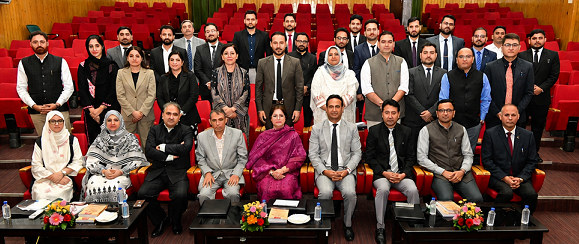
SRINAGAR, Aug 22: The Jammu & Kashmir Judicial Academy, under the patronage of Acting Chief Justice, High Court of Jammu & Kashmir and Ladakh, and the guidance of Justice Rajnesh Oswal, Judge, High Court of Jammu & Kashmir and Ladakh and Chairman, Governing Committee, the J&K Judicial Academy, today a one day workshop on "Arbitration & Conciliation Act, 1996; Mediation: Role of Judges in referral with special reference to The Mediation Act, 2023" at the J&K Judicial Academy, Mominabad, Srinagar.
The workshop commenced with the inaugural address by Justice Moksha Khajuria Kazmi, Judge, High Court of J&K and Ladakh and Member, Governing Committee, J&K Judicial Academy.
In her address, Justice Kazmi emphasized that while adjudication remains central to the rule of law, arbitration, conciliation and mediation should be viewed as appropriate dispute resolution mechanisms suited to the nature and circumstances of each dispute. She observed that mediation enables parties to participate in shaping a resolution, fostering ownership and commitment to settlement.
She stressed that its success should be measured not merely by disposal but by the ability of settlements to endure and underscored the need for trained mediators, appropriate judicial referrals and institutional support. She emphasized that adjudication, arbitration and mediation are complementary instruments of justice aimed at making the justice delivery system more accessible, humane, responsive and effective.
The first technical session was conducted by Justice Rashid Ali Dar, Former Judge, High Court of J&K and Ladakh, on "Arbitration: Basic Principles, Court's Role and Interface with Judicial Proceedings." He emphasized that arbitration is a legally recognized mechanism distinct from, yet closely connected with the judicial system requiring a balance between party autonomy and minimal judicial intervention.
He stressed that courts should facilitate rather than obstruct arbitration while ensuring fairness, legality and natural justice. The session covered key provisions of the Arbitration and Conciliation Act, 1996, including arbitration agreements, referral to arbitration, appointment and jurisdiction of arbitral tribunals, interim measures and the complementary roles of courts and tribunals.
Thereafter, Mohan Singh Parihar, Former District and Sessions Judge, conducted sessions on "Mediation - Role of Judges in Referral and Facilitation of Settlement" and "Mediated Settlements - Recording, Enforcement, Challenges and Implementation." He provided practical insights into mediation as an important ADR mechanism and emphasised the role of judicial officers in identifying suitable cases for mediation. He stressed that before making a referral, the court should understand the facts and nature of the dispute and assess whether there is an element of settlement that can appropriately be explored through mediation.
He also explained the procedural framework governing mediation, including referral to District Mediation Centres, the role of mediators and the procedure to be followed in successful and unsuccessful mediations. He highlighted the importance of considering ADR at the appropriate stage of proceedings and discussed the objectives of Section 89 CPC, including providing effective relief to litigants, reducing pendency and easing the burden on courts. He explained the five ADR mechanisms-arbitration, conciliation, LokAdalat, judicial settlement and mediation-and their appropriate application depending upon the nature of the dispute. |
