news details |
|
|
| Modi, Putin agree to strengthen India-Russia strategic partnership | | PM accepts Russian Prez invitation for annual summit talks, meets Iranian President, UN Secretary General | | 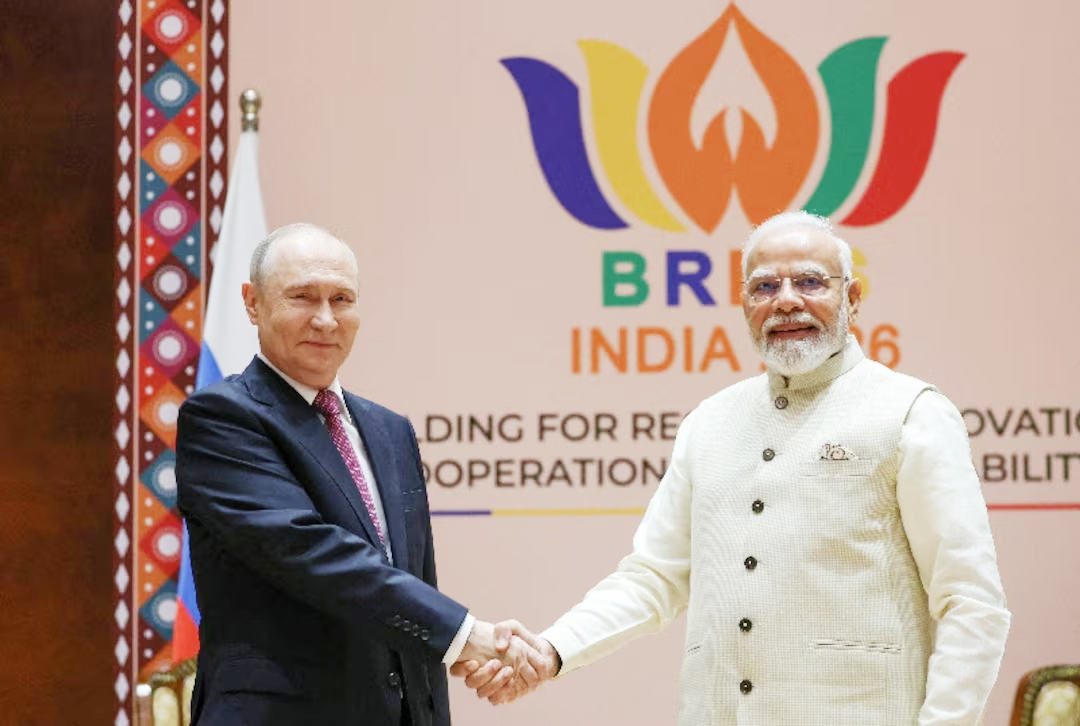 Early Times Report Early Times Report
NEW DELHI, Sept 11: Russian President Vladimir Putin on Friday stressed the BRICS grouping was not against anyone and Moscow was open to working with the whole world as he agreed to further strengthen bilateral ties with India and slammed the economic restrictions imposed by the West on his country.
Prime Minister Narendra Modi raised the safety of Indian seafarers in the Black Sea during bilateral talks with Putin and reiterated India's readiness to support any peace initiative to end the Ukraine conflict. The meeting took place hours after Putin landed in New Delhi on a three-day visit to participate in the high-stakes BRICS summit. After the talks, Modi and Putin travelled in the same car. Addressing a gathering of BRICS business leaders ahead of the summit, Putin said Russia was ready to work with partners on infrastructure and logistics projects, including the Arctic Transport Corridor and North-South Transport Corridor, as well as cooperation in technology, artificial intelligence, unmanned transport, finance, tourism and industry.
"We are not against anyone," Putin said. "We are in favour of our interests," while asserting that BRICS remained open to cooperation with the wider world.
Putin said the proposed NDB-based investment platform would seek to mobilise private-sector funding and make BRICS economies more competitive. He expressed hope that other BRICS members would support the initiative.
"We need funding," Putin said, adding that the NDB was already doing significant work but could provide the basis for a broader investment mechanism. Click here to watch video
Signalling their resolve to maintain deeper engagement across diverse sectors, Modi and Putin agreed to strengthen the India-Russia Special and Privileged Strategic Partnership. According to an Indian readout, the partnership continues to register "significant growth" and has "shown resilience in the backdrop of geopolitical uncertainties".
While reviewing trade and investment ties, the two sides resolved to push annual bilateral trade to USD 100 billion by 2030, up from the current USD 65 billion.
Modi said he and the Russian leader talked about closer trade ties, including implementation of the 'Programme for Economic Cooperation 2030' besides delving into engagement in areas like infrastructure, energy, technology, defence and culture.
The Ministry of External Affairs (MEA) said in the readout that Modi accepted Putin's invitation to travel to Russia for the annual summit talks between the two countries.
In their over 45-minute talks, Modi and Putin also agreed to step up cooperation in defence, critical minerals, civil nuclear energy, fertiliser supplies and people-to-people exchanges. The two leaders "shared perspectives on key regional and global issues of mutual interest, including the conflicts in West Asia and the Black Sea region which have impacted maritime trade and the safety and security of Indian seafarers", the MEA said in the readout.
"The Prime Minister once again reiterated that dialogue and diplomacy was the way forward in resolving conflicts and India stood ready to assist in peace efforts," it said.
Five Indian seafarers died in the Black Sea due to ongoing Russia-Ukraine hostilities, prompting India to strongly raise the incidents with both Moscow and Kyiv.
The two leaders also visited the INNOPROM India exhibition at the Bharat Mandapam and interacted with the participants.
"President Putin invited Prime Minister to visit Russia for the 24th India-Russia Annual Summit. The prime minister accepted the invitation. The dates of the summit will be decided as per mutual convenience through diplomatic channels," the MEA said.
Speaking at the business forum after his talks with Putin, Modi said progress in global trade is possible only when sea lanes are secure, supply routes remain open, and seafarers are safe. "That is why India is a staunch supporter of freedom of navigation and the safety of seafarers," he said.
"The world is always changing," Putin said, arguing that the economic weight of the traditional growth centres of the second half of the 20th century was being replaced by new engines of growth.
The Russian President framed the expanding BRICS economic architecture as an effort to advance national interests rather than exclude other countries. He argued that cooperation among governments, businesses and academia was helping BRICS build a resilient platform for global growth based on innovation and national priorities.
BRICS, originally comprising Brazil, Russia, India, China and South Africa, expanded in 2024 to include Egypt, Ethiopia, Iran, the United Arab Emirates and Saudi Arabia, with Indonesia joining in 2025. Belarus, Bolivia, Kazakhstan, Cuba, Malaysia, Nigeria, Thailand, Uganda, Uzbekistan and Vietnam became BRICS partner countries last year.
Meanwhile, Modi on Friday pressed Iranian President Masoud Pezeshkian to resolve the West Asia conflict through dialogue and diplomacy while highlighting the vital need for safe navigation and safety of seafarers.
Meeting for the second time in under two weeks, the two leaders discussed India-Iran relations, with the overall situation in West Asia taking centre stage.
The talks took place hours after the Iranian leader arrived in the national capital to attend the BRICS summit. This is Pezeshkian's first visit to India as the president.
His visit assumes significance as it comes amid sudden spike in overall tensions in West Asia following fresh hostilities and the US slapping new punitive economic measures against Iran.
Shortly after the meeting, Modi described Pezeshkian's trip to India as "more special because it is his first visit" to the country.
"We talked about the India-Iran friendship. We believe that we should move forward with a long-term and win-win strategy," Modi said on social media.
"The prevailing situation in the region was also discussed. India remains steadfast in its commitment to the pursuit of enduring peace," he said.
Meanwhile, Modi also met with UN Secretary-General Antonio Guterres ahead of the BRICS Summit, as both leaders held discussions on various issues, including ongoing conflicts and freedom of navigation, sustainable development, human-centric AI and global food security.
Both leaders also underscored the significance of "multipolarity" and the need to reform multilateral institutions, including the UNSC, to "reflect contemporary realities," the Ministry of External Affairs (MEA) said. |
|
|
|
|
|
|
|
|
|
|
|
|
| |
| |
|
|
|
|
 |
|
|
