news details |
|
|
| Article 370 scrapped without firing a single bullet, says Amit Shah | | | 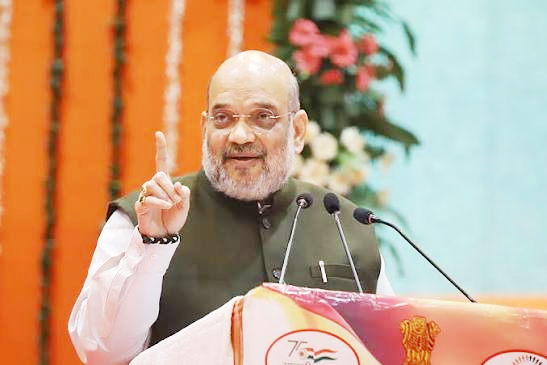
Early Times Report
Jammu, Sept 14: Union Home Minister Amit Shah on Monday asserted that Jammu and Kashmir stands fully integrated with the rest of India, declaring that the historic abrogation of Articles 370 and 35A was accomplished without bloodshed or the firing of a single bullet.
Speaking to reporters, Shah described the constitutional change as a landmark achievement of the Narendra Modi government. He said the decision had removed the last barriers of separateness and brought the region into complete constitutional and territorial unity with the country.
Shah underlined that the abrogation was carried out in a peaceful and orderly manner, contrasting it with the violence that many had predicted. “Jammu and Kashmir is now fully integrated with India. Articles 370 and 35A were abrogated without a single bullet being fired,” he said, placing the move at the heart of the government’s efforts to strengthen national integrity.
The Home Minister linked the decision to the broader national-security doctrine pursued by the Centre. He reiterated the government’s zero-tolerance policy against terrorism and cited a series of decisive military actions as proof of India’s resolve. Shah referred to the surgical strikes across the Line of Control, the air strikes that followed, and Operation Sindoor as clear demonstrations of the country’s determination to respond firmly to any threat to its security.
These operations, he said, reflected a consistent approach that no longer tolerates cross-border terrorism or attacks on Indian soil. By connecting the Kashmir policy with the larger counter-terror framework, Shah presented the abrogation of Articles 370 and 35A as part of a comprehensive strategy aimed at securing both the constitutional unity and the physical security of the nation.
The remarks come amid continued political debate over the long-term impact of the 2019 constitutional changes. Shah’s comments sought to reinforce the government’s narrative that the region has moved beyond its special status and is now an inseparable part of India, both in law and in practice. |
|
|
|
|
|
|
|
|
|
|
|
|
| |
| |
|
|
|
|
 |
|
|
