 Early Times Report Early Times Report
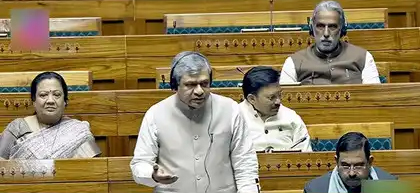
New Delhi, Dec 5: The Udhampur–Srinagar–Baramulla Rail Link (USBRL), one of India’s most challenging post-independence railway projects, has generated more than 5 crore man-days of employment, Union Minister for Railways Ashwini Vaishnaw informed the Rajya Sabha on Thursday.
The 272-km-long USBRL project, recently commissioned in full, has officially connected the Kashmir Valley with the rest of the country through an all-weather, high-reliability rail network. The ambitious project spans the districts of Udhampur, Reasi, Ramban, Srinagar, Anantnag, Pulwama, Budgam and Baramulla.
Vaishnaw described the USBRL as “one of the most difficult railway line projects undertaken in independent India”, given the treacherous terrain of the young Himalayan region, marked by unpredictable geology and complex engineering challenges.
The project features two modern engineering marvels: Chenab Rail Bridge, the world’s highest railway bridge, stretching 1,315 metres with a 467-metre arch span and rising 359 metres above the riverbed in Reasi.
Anji Khad Bridge, India’s first cable-stayed railway bridge, with the deck standing 331 metres above the riverbed and a 193-metre main pylon.
In addition to the main rail infrastructure, over 215 km of approach roads—including a tunnel and 320 small bridges—have been built. This road network has significantly improved rural connectivity and facilitated socio-economic development across the region.
With the completion of the project, Indian Railways has introduced two Vande Bharat Express services between Shri Mata Vaishno Devi Katra and Srinagar (Train Nos. 26401/02 and 26403/04). Six pairs of DEMU/MEMU services are operating on the Qazigund–Srinagar route, while five pairs cater to the Srinagar–Baramulla sector.
Officials say the all-weather connectivity has given a major boost to tourism, streamlined passenger movement and improved freight logistics. Apple growers, in particular, are benefiting from faster transportation to markets across India. The rail line has also eased the movement of cement and other essential commodities into the Valley.
To further expand the network, surveys for the Baramulla–Uri new line (46 km) and Banihal–Baramulla doubling (118 km) have been completed, and Detailed Project Reports (DPRs) have been prepared. Vaishnaw said project sanctions now await consultations with stakeholders, including the J&K Government, and mandatory appraisals by NITI Aayog and the Ministry of Finance.
He added that sanctioning of new projects remains a “continuous and dynamic process,” with timelines dependent on approvals at various levels. |
