news details |
|
|
| ‘Infiltrators won’t choose India’s PM or CM’ | | | 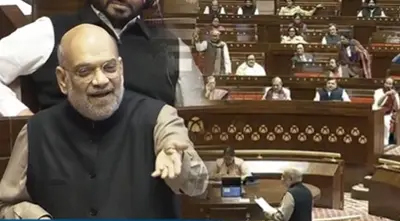 Sandeep Bhat Sandeep Bhat
Early Times Report
Jammu, Dec 10: Union Home Minister Amit Shah on Wednesday launched a sharp counter-attack on the Congress-led Opposition during a heated debate on electoral reforms in the Lok Sabha, accusing them of spreading “lies” about the ongoing Summary Revision (SIR) of electoral rolls and attempting to mislead the nation.
“The Prime Minister of this country and the Chief Ministers of states will not be decided by infiltrators. That right belongs only to the citizens of India,” Shah thundered, adding that Narendra Modi became Prime Minister because of the people’s mandate, not because of any “grace” from the Opposition.
The debate, part of the Winter Session, saw the Opposition repeatedly raise the Election Commission’s Summary Revision exercise, alleging irregularities and “voter deletion” targeting specific communities.
Shah firmly rejected demands for a detailed parliamentary discussion on the SIR, pointing out that the Election Commission is a constitutional body independent of the government.
“We do not conduct elections. The Election Commission is not under the government. If we discuss the SIR here, who will answer questions on it?” Shah asked, reminding members that Article 324 vests superintendence of elections in the Commission, while Articles 326 and 327 govern voter eligibility and parliamentary powers over electoral matters.
Dismissing Congress claims as politically motivated, the Home Minister said SIRs have been conducted thrice since 2000 – once under the UPA government of Manmohan Singh and twice under NDA rule – without any protest from the Opposition at the time.
“This is a routine process to purify the voter list. If the voter list itself is impure, how can elections be pure?” he asked, asserting that the Supreme Court’s directives had also guided such revisions and that it is the Commission’s constitutional duty to determine genuine voters.
Taking a direct swipe at Congress leader Rahul Gandhi, who had claimed massive voter discrepancies using the example of a single house in Haryana allegedly showing an implausibly high number of voters, Shah revealed that the Election Commission had already verified and found the claim “completely false”.
“I saw the worry lines on your face,” Shah remarked, adding that he would respond point-by-point without getting provoked. “An attempt is being made to build a false narrative of vote theft,” he said.
In a stinging historical rejoinder, Shah accused the Congress of hypocrisy on electoral integrity by citing three instances from the party’s own past:
The 1946 election for Congress president (widely seen as choosing independent India’s first Prime Minister), where Sardar Vallabhbhai Patel secured an overwhelming majority of provincial committee votes, yet Jawaharlal Nehru was chosen.
The 1975 Allahabad High Court judgment that disqualified Indira Gandhi from Rae Bareli for electoral malpractices – an episode Shah labelled as “vote theft”.
The subsequent 39th Constitutional Amendment that retrospectively granted the Prime Minister immunity from electoral court challenges, and Indira Gandhi’s decision to supersede three senior Supreme Court judges to appoint Justice A.N. Ray as Chief Justice in 1973.
“Indira Gandhi gave herself immunity that even the Election Commission does not enjoy,” Shah said, turning the Opposition’s criticism of ECI autonomy back on the Congress.
Defending the government’s stance, Shah clarified that Parliament had lost two days of the Winter Session because the Opposition kept insisting on discussing only the SIR instead of broader electoral reforms.
“BJP and NDA have never run away from discussion. When the Opposition finally agreed to discuss comprehensive electoral reforms, we spoke for two full days,” he said.
The Home Minister emphasised the government’s commitment to clean and transparent elections while asserting that the purity of the electoral roll is the foundation of democracy and that no outsider or infiltrator would be allowed to influence who governs India.
The debate ended with the Treasury benches applauding Shah’s point-by-point rebuttal, while the Opposition continued to protest, demanding a separate discussion on the ongoing voter-list revision exercise. |
|
|
|
|
|
|
|
|
|
|
|
|
| |
| |
|
|
|
|
 |
|
|
