 Early Times Report Early Times Report
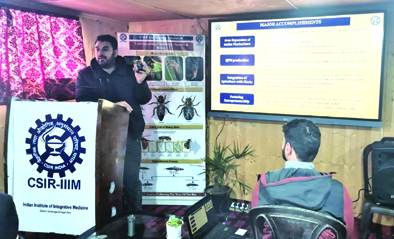
PULWAMA, Jan 29: The CSIR-Indian Institute of Integrative Medicine (CSIR-IIIM), Jammu, under the flagship CSIR Floriculture Mission, has initiated a 07-Day Entrepreneurship and Skill Development Programme on apiculture based bio-enterprises at its Field Station, Bonera, Pulwama. The programme is strategically designed to augment scientific competencies, technological know how and entrepreneurial acumen among farmers and stakeholders, thereby fostering high value, knowledge driven agri-enterprises in the Union Territory of Jammu and Kashmir. The programme has drawn participation of 100 farmers, rural youth, women entrepreneurs, students and agri-stakeholders representing the districts of Baramulla, Budgam, Shopian, Anantnag, Srinagar and Pulwama. The initiative underscores apiculture as a climate resilient, ecologically sustainable and economically viable enterprise, with a dual role in income enhancement and ecosystem service provisioning, particularly pollination mediated crop productivity.
The programme was virtually inaugurated by Dr Zabeer Ahmed, Director, CSIR-IIIM, Jammu, who in his interaction with the participants emphasized that apiculture represents a convergence point between agricultural intensification and biodiversity conservation. He stated that the CSIR Floriculture Mission is among the multiple farmer oriented initiatives of Ministry of Science and Technology, GOI and has emerged as a transformative platform for science led rural development by enabling crop diversification, production of elite planting material, integration of apiculture with floriculture and establishment of market oriented value chains. He highlighted that the Mission under the visionary supervision of Dr Jitendra Singh, Hon'ble Union Minister for Science and Technology, has benefitted over 3,500 farmers across Jammu and Kashmir, significantly strengthening livelihood resilience and resource use efficiency in small and marginal landholdings. Er. Abdul Rahim, Head, CSIR-IIIM Srinagar, highlighted the critical role of apiculture in strengthening agro-ecosystem functionality, enhancing pollination efficiency and conserving entomofaunal biodiversity. He emphasized that adoption of scientifically validated apicultural practices not only improves crop yield and quality but also contributes to long term ecological sustainability and climate adaptation strategies in fragile Himalayan agro-ecosystems.
Dr Shahid Rasool, Nodal Scientist, CSIR Floriculture Mission, highlighted the strategic relevance of scientific beekeeping, colony health management, quality assurance protocols and value addition in honey production. He informed that CSIR-IIIM has played a pivotal role in mainstreaming apiculture within nectar bearing agro-systems through the distribution of 1650 honey bee colonies across 160 farmer clusters, Self-Help Groups and Farmer Producer Organizations (FPOs). Furthermore, 125 farmer clusters and FPOs have been incubated through structured capacity building interventions focusing on hive management technology, disease and pest management, post-harvest handling, branding and market integration, he added. |
