 Early Times Report Early Times Report
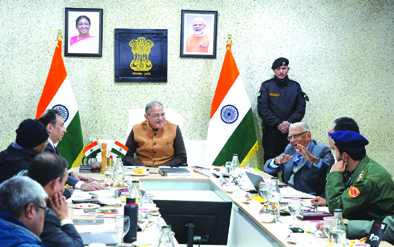
LEH, Jan 29: The Lieutenant Governor of Ladakh, Kavinder Gupta, chaired the 15th meeting of the State Board for Wildlife at the Lieutenant Governor's Secretariat today, underscoring that national security remains paramount while undertaking any wildlife conservation and boundary rationalisation exercise in the Union Territory.
During the meeting, the Lt Governor led detailed deliberations on critical wildlife conservation issues, with particular focus on the rationalisation of boundaries of wildlife sanctuaries in Ladakh. He emphasised the need to strike a balanced, pragmatic approach that safeguards national security interests, protects local community livelihoods, and ensures effective conservation of Ladakh's unique and endangered wildlife.
At the outset, Additional Principal Chief Conservator of Forests, Shri S. Rajesh, briefed the Board on its mandate, agenda items, and initiatives undertaken by the Forest, Ecology and Environment Department. These included rescue and rehabilitation of wild animals from April to December 2025, mitigation of human-wildlife conflict, wildlife studies, issuance of protection advisories, and participation in meetings of the Standing Committee of the National Board for Wildlife for project clearances.
The Hon'ble Lt Governor took note of the agenda presented by Wildlife Warden Shri Mandeep Mittal regarding the rationalisation of boundaries of Karakoram (Nubra-Shayok) Wildlife Sanctuary and High Altitude Cold Desert (Changthang Wildlife) Sanctuary. The presentation highlighted inconsistencies in the original 1987 notifications and boundaries of both wildlife sanctuaries and Hemis National Park. The Lt Governor was briefed on the process initiated after the formation of the Union Territory and the assessment work undertaken by the Wildlife Institute of India for the rationalisation ifhe boundaries of the wildlife sanctuaries.
During extensive discussions, the Hon'ble Lt Governor carefully considered concerns raised by stakeholders, including the Army, paramilitary forces, police, local communities, and wildlife experts. It was noted that existing proposals could potentially bring a significant portion of Ladakh's land area under protected zones, creating operational, developmental, and administrative challenges.
The Hon'ble Lt Governor acknowledged the Army's commitment to wildlife conservation and concurred that operational and strategic areas critical to national security must be kept outside protected zones, especially in sensitive border regions. He also took cognisance of issues raised by Ladakh Police regarding development initiatives, including the Vibrant Village Programme and administrative restructuring.
|
