news details |
|
|
| Amid challenges, CM Omar presents Rs 1,13,767 crore reform‑driven Budget | | | 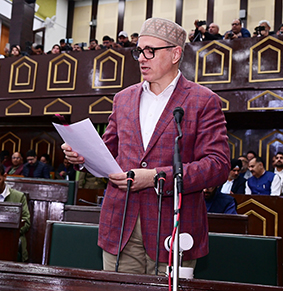
Early Times Report
Jammu, Feb 6: Chief Minister Omar Abdullah presented his second Budget in the Assembly today, striking a tone of humility and determination as he sought to balance fiscal discipline with ambitious reforms. Calling the Budget “a fiscal compass,” Abdullah said it was designed to steer Jammu & Kashmir through turbulence caused by terrorism, floods, and global economic headwinds.
The Chief Minister acknowledged the twin shocks of the past year: the barbaric terrorist attack at Pahalgam and the devastating floods that battered Jammu. Both disasters crippled tourism, handicrafts, horticulture, and agriculture, leaving families under financial stress. “These calamities have accentuated fiscal challenges, but we will turn obstacles into stepping stones,” Abdullah told the Legislative Assembly.
While tabling the budget for 2026-27 in the Legislative Assembly, the Chief Minister said that the financial plan aims to lay a strong foundation for sustainable growth, social harmony, and economic prosperity in the union territory.
He said his government is committed to transforming the UT into a modern, progressive, and economically vibrant region by promoting investment, innovation, and participatory governance.
“With deep humility and unwavering resolve, I rise today to present my second Budget as Finance Minister. It is a privilege to be entrusted with the responsibility of shaping the financial future of our land,” Chief Minister said while presenting the Budget.
Describing the Budget as a roadmap for development, he said, "This Budget is not merely a ledger of figures, it is a fiscal compass charting our path towards a brighter horizon. It lays strong foundations for enduring economic growth, social harmony and sustainable prosperity."
Chief Minister said that four major hydropower projects (Pakal Dul, Ratle, Kiru, and Kwar) with a combined capacity of 3,014 MW are under rapid execution.
The 1,000 MW Pakal Dul and 624 MW Kiru projects are scheduled for commissioning this year. The budget allocates Rs 1,718 crore for the power sector, aiming to achieve round-the-clock electricity supply by 2027-28. Under PM Surya Ghar Muft Bijli Yojana, 16,816 households have been solarized, with plans to install rooftop solar systems for 2.22 lakh AAY households.
The Chief Minister further said that J&K’s road network is witnessing a massive upgrade with Rs 61,528 crore investment in construction of the Delhi-Amritsar-Katra expressway, five National Highways, and two Ring Roads for Jammu and Srinagar. The Central Government has sanctioned 19 new National Highway projects worth Rs 10,637 crore. Under PMGSY-IV, 316 road projects covering 1,781 km have been approved for Rs 4,224 crore. The Public Works sector receives Rs 4,061 crore allocation.
“Under Jal Jeevan Mission, over 15.62 lakh rural households (81 percent) have received piped water connections, with 867 villages achieving Har Ghar Jal certification. The Jal Shakti sector has been allocated Rs 2,558 crore, an increase of Rs 545 crore from the previous year”, he pointed out.
In a major boost to employment, the Chief Minister announced that 7,650 candidates have been appointed to government service in 2025 through a transparent, merit-based recruitment process. He proposed fast-tracking recruitment for an additional 23,800 posts, including 2,800 gazetted, 14,000 non-gazetted, and 7,000 Class-IV positions. Additionally, 910 compassionate appointments have been provided.
A comprehensive skill development framework has been adopted, covering foundational skilling at school level, career launchpad programs for youth, industry-ready technical training through restructured polytechnics and upgraded ITIs, and continuous upskilling initiatives.
The agriculture sector is undergoing significant transformation with cultivated area expanding from 12.71 lakh hectares to 13.50 lakh hectares. The Seed Replacement Rate has increased from 12 percent to 22 percent, while protected cultivation has expanded with 332 hi-tech greenhouses and 848 polyhouses established. Over 8 lakh farmers have been onboarded onto Kisan Sathi and KKG apps, with 1,300 Kissan Khidmat Ghars operational.
In a transformative move for the dairy sector Budget 2026–27 charts roadmap for growth amid terror, floods and economic challenges
Big thrust on power, infrastructure, jobs, healthcare and social security
Welfare, digital governance and investment-led development at the core of fiscal vision
The Agriculture and Allied sectors have been allocated Rs 1,878 crore under capital expenditure. Fruit production increased from 26.43 lakh MT to 26.92 lakh MT, with a target of 29.72 lakh MT by 2029-30.
Despite challenges, J&K recorded over 1.61 crore tourist visits in 2025. The government has launched the JK Tourism Mobile App for verified real-time information and integrated booking services. Over 1,600 registered homestays have been established in Kashmir Division and 300+ in the Jammu Division, with concessional assistance from J&K Bank.
The second Kashmir Marathon 2025 recorded over 3,000 registrations from 27 States/UTs and 11 countries, garnering Rs 2.11 crore in sponsorships. In 2026-27, the government will organize an International Film Festival in association with the National Film Development Corporation. The Tourism and Youth Affairs sector has been allocated Rs 472 crore, an increase of Rs 61 crore.
More than 4,000 health infrastructure facilities have been developed, including 15 Medical Colleges, two AIIMS, and two State Cancer Institutes. During the current year, 548 medical seats will be added, comprising 340 MBBS, 128 PG, 34 PG (Ayurveda), and 46 DNB seats. AIIMS Kashmir will be commissioned by June 2026.
Advanced diagnostic facilities are being expanded with installation of 1.5 Tesla MRIs in new GMCs and 3 Tesla MRIs at major institutions. PET-Scan facilities will be installed at GMC Srinagar and extended to GMC Kathua. The government will establish dedicated Emergency and Accident Hospitals at Uri and Poonch to strengthen healthcare in border areas. The Health & Medical Education sector has been allocated Rs 1,866 crore.
In a significant public health initiative, the government will roll out a comprehensive Cancer Control Strategy in collaboration with NITI Aayog and ICMR, focusing on prevention, early diagnosis, and improved treatment facilities.
Path-breaking reforms under the National Education Policy have commenced with pre-primary classes in 15,550 schools. The government has provisioned Rs 30 crore for establishing 5,000 Kindergartens. School infrastructure is being upgraded with 396 Exemplar Schools under PM-SHRI, 4,200 Smart Classrooms, and 172 Atal Tinkering Labs.
These reforms have led to significant improvement in results, with Class 10 and 12 pass percentages reaching approximately 85 percent in 2025-26, marking one of the best performances in recent years. The JK e-Pathshala DTH Channel has been launched to ensure universal access to quality education in remote areas, with over 300 educational videos already produced.
The School & Higher Education sector has been allocated Rs 1,513 crore, with plans to make five new college buildings functional in 2026-27 and complete construction of several others.
In a major relief for vulnerable sections, the government enhanced monthly pension rates from Rs 1,000 to Rs 1,250 for beneficiaries below 60 years, to Rs 1,500 for those aged 60-80 years, and to Rs 2,000 for those above 80. Coverage has been expanded from 7.35 lakh beneficiaries in March 2024 to 10.19 lakh in January 2026, with the annual pension outlay increased from Rs 1,209 crore to Rs 1,755 crore.
The Marriage Assistance Scheme has been enhanced from Rs 50,000 to Rs 75,000 for girls from AAY families, with beneficiaries increasing from 26,000 to 44,302. The Ladli Beti Scheme has grown from 16,095 beneficiaries in 2017 to 1.92 lakh girl children enrolled by late 2025, with Rs 450 crore provisioned for 2025-26.
Under NRLM, 96,000 Self-Help Groups have been formed, mobilizing over 7.84 lakh rural households. The government has successfully implemented free ridership for women on all government-owned public transport from April 2025, making J&K one of the few regions in the country to operationalize zero-fare travel for women. |
|
|
|
|
|
|
|
|
|
|
|
|
| |
| |
|
|
|
|
 |
|
|
