 Early Times Report Early Times Report
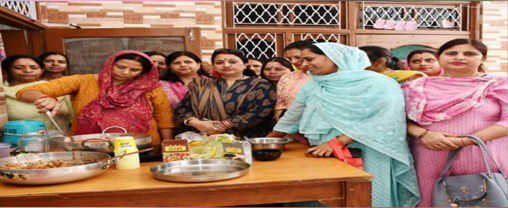
JAMMU, May 13: Training Programme on "Kandi's Hidden Treasures can boost Rural Women's Income Via Indigenous Fruits" was organized by the Division of Agricultural Extension Education, SKUAST-Jammu (sponsored by JKST&IC project) for the Rural Women & Youths of village Palli, of District Kathua under the noble guidance & dynamic leadership of Hon'ble Vice Chancellor, Prof. B.N. Tripathi. Prof Poonam Parihar (PI of the JKST&IC project), Division of Agricultural Extension Education, Dr. Neerja Sharma (Co-PI of the JKST&IC project) & Chief Scientist, Horticulture, KVK Samba, Dr Anamika Jamwal Chief Scientist (Plant Pathology), KVK, Kathua & S. Sarabjeet Singh, Technical officer, Division of Agricultural Extension Education attended & participated in the Programme.
While addressing the farmers (rural women & youth), Prof Poonam Parihar, Principal Investigator of the Project highlighted that the underutilized minor fruits of the Kandi region in Jammu-such as Amla, Jamun, Bael, Karonda, Ber, and various citrus fruits (Kimb, Jhamiri, Galgal)-hold significant potential to boost the income of rural women. Through value addition, such as producing jams, pickles, squashes, and powders, these "hidden treasures" can be transformed into high-value products, providing sustainable livelihoods and empowering women, often working through self-help groups (SHGs). The Kandi areas possess diverse, hardy minor fruits that thrive in rain-fed conditions and offer high nutritional and medicinal value, Amla (Indian Gooseberry) & Bael: Processed into candies, murabbas, powders, and squashes. Karonda & Ber: Turned into pickles, jellies, squashes/drinks etc.
The Kandi areas of the Jammu region (foothills and plains) are rich in underutilized "minor" fruits that possess high nutritional and commercial value. These fruits, often overlooked, are crucial for local dietary habits and the economic empowerment of women and youth through value-added products like jams, pickles, and jellies. Training in post-harvest operations (grading, packaging, and branding) is being utilized to enable self-employment for women and youth in rural Jammu. Many of these fruits are rich in Vitamin C, iron, and antioxidants. These fruits are well-adapted to the sub-tropical, often dry conditions of the Kandi region, making them excellent for sustainable agriculture.
Agripreneurship has the potential to contribute to a range of social & economic development such as employment generation, income generation, poverty reduction & improvements in nutrition, health & overall food security in the National economy. It will improve the productive efficiency of the natural resources and provide better and more livelihoods options to farmers and agriculture workers. The demonstrations/training on post-harvest operations like grading, Packaging Branding & Marketing would encourage self-employment to rural people and value addition of locally available minor fruits. She further added that Entrepreneurs can create innovative products, enhance agricultural incomes, and contribute to sustainable practices not only providing higher value products but also creates local jobs in processing and marketing.
Dr Neerja Sharma, Chief Scientist, Horticulture, KVK, Samba said that the Aripreneurship has potential to generate growth, diversifying income, providing widespread employment and entrepreneurial opportunities in rural areas and the minor fruits with their diverse characteristics and untapped potential, offer significant opportunities for value addition and entrepreneurship which enhances farmers' incomes by leveraging their unique qualities, nutritional benefits, and cultural significance. She laid Scientific practical demonstrations on Value addition of bi products of lemon (Citrus Fruit) into value added bi-products e.g., lemon Pickle, lemon squash and also gave demonstration on the preparation of tomato puri & Sweets of Ragi (Ladoo's of Ragi). |
